

Your phone’s probably in your hand right now. Maybe the case is yellowing, scuffed, or just boring. Maybe you bought a cheap clear one that did the job for a month, then started looking tired. Or maybe you’ve been scrolling custom designs and thinking, “I could make something better than that myself.”
You can, but only if you treat it like a small build job, not a quick craft shortcut.
A good custom case has to do three things at once. It needs to look sharp, fit the exact iPhone model properly, and still come off cleanly when the phone eventually needs a screen, battery, charging port, or housing repair. That last part gets ignored in most design guides, and it’s where a lot of DIY jobs go wrong in real life.
From Bland to Brilliant Your Personalised iPhone Case Journey
The appeal is obvious. A phone case isn’t just a shell anymore. It’s the bit you touch all day, throw on the desk, pull out at the shops, and notice every time you answer a message. People want something that feels like theirs, not another black rectangle.
That demand isn’t small. The global customizable phone accessories market was valued at USD 40 billion in 2024 and is projected to reach USD 90 billion by 2032, with a CAGR of 12%, driven by demand for products that combine self-expression with function, according to Future Data Stats on the customizable phone accessories market.
A lot of Perth customers start in the same place. They see generic cases at the kiosk, then decide they want something more personal. A favourite band graphic. Their dog. A clean monogram. A WA-inspired colour palette. Sometimes it’s simple and sometimes it’s loud, but the reason is the same. People want the phone to reflect their style, not the supplier’s catalogue.
If you’re interested in the wider buying behaviour behind that, this piece on the power of personalization in modern shopping is worth a read. It lines up with what repair techs and accessory makers see every day. Buyers don’t just want protection. They want recognition, identity, and something that doesn’t look mass-produced.
What actually works
The good news is you don’t need commercial print equipment to customise iphone case projects well. Plenty of strong results come from straightforward methods:
- Paint on a prepared case if you want one-off artwork.
- Decals or vinyl if you want crisp graphics without a steep learning curve.
- Resin accents if you want depth, but only if you understand the repair trade-offs.
- Laser engraving if you care more about durability than bright colour.
Practical rule: The best custom case is the one you’ll still be happy using six months from now, not the one that looked clever on the workbench for ten minutes.
A custom case should still be a case first. If it slips, lifts, cracks, blocks buttons, or creates repair problems later, the design wasn’t successful no matter how nice it looked on day one.
Planning Your Perfect iPhone Case Design
A lot of bad case jobs are decided before any paint, vinyl, or print touches the shell. Someone orders the wrong model, builds artwork around a flat mock-up, then finds the camera cut-out has chopped through a face, logo, or line of text. I see the result later in the shop when the owner is annoyed with the finish and still stuck with a case that protects poorly.

Start with the exact iPhone model
Check the phone in Settings > General > About and match both the model name and model number before buying anything. That sounds basic, but small differences in camera size, button placement, speaker holes, and MagSafe ring position are enough to ruin a custom layout.
This matters for more than looks. A case that fits badly can press on buttons, sit unevenly around the screen edge, or leave corners exposed after a drop. If the phone already lives a hard life in the car, on site, or in a toolbox, start with a heavy-duty phone cover built for impact protection and design around that shape instead of forcing artwork onto a flimsy shell.
Build around the case shape
Good artwork on the wrong layout still looks amateur. A phone case has interruptions everywhere. The camera island cuts into the top corner. Curved edges pull decals out of line. Raised lips can distort wraps if the material is too thick or poorly trimmed.
Keep the main subject lower and more central than you first think. Text near the camera corner often ends up looking cramped. Fine borders also cause trouble because any slight shift during application is obvious once the case is snapped on.
A quick pencil mock-up helps. Even a rough sketch shows whether the design still reads once the cut-outs are in the way.
Use artwork that will survive printing or application
Screenshots from Instagram, Facebook, or old message threads usually look acceptable on a phone screen and rough on a case. For printed work, use a high-resolution original file. For decals or laser work, use clean shapes and sharp edges. If the image already looks soft when you zoom in, the finished case will not improve it.
Use this checklist before you commit:
- Pick the final image first. Swapping files at the end often changes the crop and throws the whole layout off.
- Zoom right in. Hair, outlines, and small lettering show quality problems first.
- Leave clear space around corners and the camera opening. Crowded designs age badly.
- Test the design at real size. If it feels busy on screen, it will feel busier in your hand.
Simple usually lasts better. It also hides wear better.
Match the design to the blank case
The blank case controls how well your idea holds up. Clear TPU is forgiving and easy for inserts or light decal work, but it can yellow over time and flexible edges can lift badly applied graphics. Hard polycarbonate suits print and engraving better because the surface stays more stable. Matte shells hide fingerprints and small scratches, while glossy shells show off photos and colour but also every trapped speck of dust.
Here’s the practical version:
| Base case type | Best for | Watch out for |
|---|---|---|
| Clear TPU | Inserts, simple decals, light internal art | Yellowing, edge lift, softer feel |
| Hard polycarbonate | Printed graphics, detailed layouts, engraving | Less flex during installation |
| Matte case | Minimal art, painted details, understated finish | Muted photo reproduction |
| Soft silicone | Grip and comfort | Poor decal adhesion, hard to keep edges neat |
If you want a low-maintenance finish, engraving is worth considering. Perth makers offering custom laser engraving services can produce clean, durable results on suitable hard-shell materials without adding the thickness or peeling risk you get from layered decorations. The trade-off is obvious. Engraving gives durability, not bright colour.
Plan for repairs and warranty, not just looks
This part gets missed all the time. Thick resin, metal charms, glued-on parts, and oversized corner pieces can make a case harder to remove quickly when a screen repair, battery replacement, or housing inspection is needed. Adhesives can also leave residue on the frame, and if that residue gets into speaker mesh, button gaps, or charging port edges, cleanup takes longer than the owner expects.
In Australia, a custom case usually will not void your Apple warranty by itself. Damage caused by adhesives, trapped moisture, blocked vents, bent frames, or pressure points is a different story. If your custom job sticks to the phone, interferes with fit, or causes marks on the housing, you have created your own problem.
Before customising, clean the blank case with a lint-free cloth and let it dry fully. Dust, skin oil, and pocket fluff always show up later, especially on clear shells and under glossy finishes.
Choosing Your Customisation Method
Not every method suits every phone owner. Some look excellent but age badly. Some are forgiving. Some are beautiful until the phone needs repair and the case turns into a headache to remove cleanly.

Quick comparison of the main methods
| Method | What it’s good at | What usually goes wrong | Best for |
|---|---|---|---|
| Paint and stencils | One-off artwork, colour freedom | Peeling if not sealed properly | Creative DIYers |
| Decals and stickers | Fast results, clean graphics | Edge lifting, bubbles, cheap adhesive residue | Beginners |
| Vinyl wraps | Smooth coverage, sharp finish | Stretch marks on curves, poor trimming | Clean graphic looks |
| Resin art | Depth, embedded objects, glossy finish | Bulk, weight, difficult future removal | Display-style designs |
| Laser engraving | Durable, precise, repair-friendly surface finish | Limited colour expression | Minimalist designs |
Paint and stencils
Painting gives you the most freedom. You can work with acrylics, layer colours, hand-letter names, or use stencil film for cleaner shapes. It’s forgiving while wet, and if you work on the inside of a clear case insert or under a sealing layer, it can hold up well.
Where it fails is usually at the finish stage. If the case flexes a lot and the paint layer doesn’t, you’ll see cracks or flaking.
Decals and stickers
This is the easiest route for anyone trying to customise iPhone case projects at home. Good vinyl decals can look sharp, apply quickly, and don’t require paint brushes or curing time.
The catch is adhesive quality. Cheap stickers curl at the corners, leave gum behind, or go cloudy around the edges. If you’re planning a layered decal build, less is usually better.
Vinyl wraps
Wraps sit between decals and full professional printing. They cover more surface area and can give a neat commercial finish if you trim them properly around the camera and edge curves.
They’re less forgiving than they look. Once stretched too far, they can shrink back. If you overheat them, the finish can distort. If you underheat them, corners won’t stay down.
Resin art
Resin can produce striking results with flowers, foil, glitter, or embedded shapes. It creates depth that paint and decals can’t match.
But it’s the method I’d treat with the most caution on an everyday phone. Thick resin can make a case bulky, slippery, and awkward around charging stands or pocket use. It can also complicate later servicing if decorative materials or adhesives spread where they shouldn’t.
A resin case can be a great art object. It isn’t always the best workday case.
Laser engraving and repair-friendly custom work
If you want something durable without extra layers peeling off, engraving is one of the cleaner options. It removes or marks the surface rather than building a thick decorative stack on top. For anyone exploring local industrial finishing options, these custom laser engraving services show the kind of approach that suits long-lasting minimal designs.
If protection is your first priority and custom work comes second, start with a tougher shell instead of the thinnest blank you can find. A heavy duty phone cover gives you a better base for practical use than a flimsy fashion case that only looks good in photos.
Don’t ignore eco materials
Sustainability matters to buyers now. Biodegradable and sustainable phone cases account for approximately 20% of new product launches in the broader protective case market, according to Market Research Future’s mobile phone protective cases report.
That doesn’t mean every eco case suits every DIY method. Some plant-based or biodegradable shells don’t love heavy solvents, high heat, or thick topcoats. If you’re using one, test your paint, adhesive, or sealant on a hidden area first.
Your Step-by-Step DIY Customisation Guide
The two home methods that give the best balance of result and low frustration are painting and decals. Both can look excellent if you keep the job tidy and don’t rush curing or alignment.
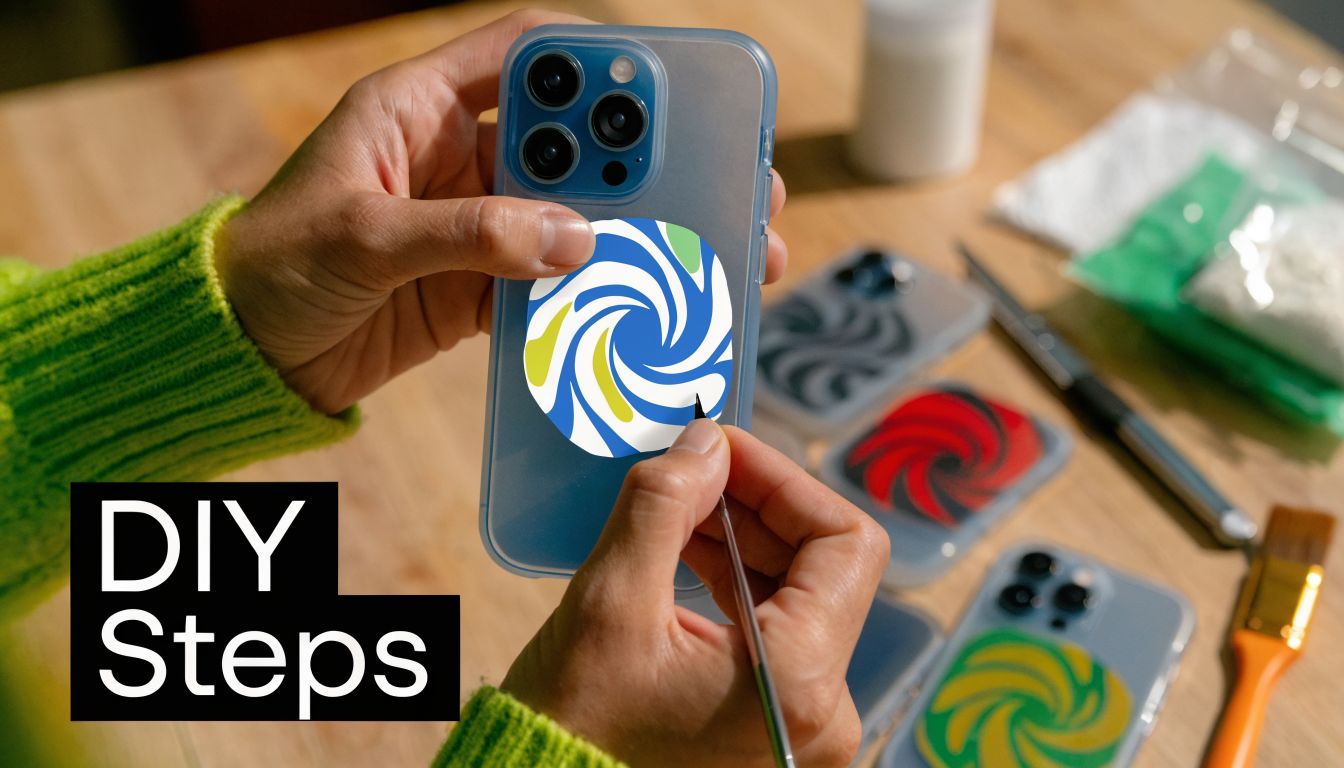
Method one with paint
Use a clean case, acrylic paint made for plastic surfaces, a fine detail brush, a broader flat brush, painter’s tape, and a soft cloth. Matte or lightly textured cases often accept paint better than greasy glossy surfaces straight out of packaging.
Follow this order:
- Wash and dry the case. Remove dust, fingerprints, and mould-release residue.
- Mask the trouble spots. Cover camera openings, button channels, and any area where thick paint could interfere with fit.
- Sketch lightly. A pencil on masking film or a very faint guide line helps keep spacing even.
- Apply thin coats. One thick coat usually drags, puddles, and chips.
- Let each layer settle before adding the next colour.
- Keep edges clean. A cotton tip is handy for quick corrections while paint is still wet.
A common mistake is painting right over flex zones on a soft TPU case with a brittle finish. The case bends every time you remove it. The paint doesn’t enjoy that.
Method two with decals
Decals are cleaner and faster, especially for logos, names, line art, or layered shapes. Use proper vinyl if you can. Paper stickers don’t last well on a case that lives in pockets and warm cars.
For a smooth application:
- Test position dry first so you know where the graphic lands around the camera.
- Peel slowly and support thin parts of the decal so they don’t stretch.
- Lay the centre first, then press outward.
- Use a card wrapped in microfibre to push out trapped air without scratching the surface.
- Warm curved areas gently with a hairdryer so the vinyl settles around edges.
Here’s a visual walkthrough that’s useful before you start:
What to avoid during DIY work
Some mistakes keep turning up:
- Too much material near ports. Thick decoration around the charging cut-out can make cable fit annoying.
- Raised lumps near MagSafe zones. Anything bulky on the back can affect how the phone sits on chargers or mounts.
- Glue where glue isn’t needed. If the decal already has adhesive, don’t “help” it with craft glue.
- Rushing the final fit test. Always clip the empty case onto the phone once before the final artwork stage if the shell feels questionable.
If a custom layer makes the case harder to remove, think about future battery or screen work before you commit.
A simple decision rule
If you want character, choose paint.
If you want clean lines and less mess, choose decals.
If you want a highly polished result but don’t have steady hands, skip both and move to a professionally produced shell rather than forcing a fiddly DIY job.
Finishing Touches and Long-Term Care
A custom case usually looks its best on day one. Its performance is put to the test by week six, after it has been in and out of pockets, sat on a car mount, and rubbed against keys, sand, and bag linings around Perth. Good finishing keeps the design presentable. It also keeps the case practical to remove later if the phone needs a battery, screen, or charging port repair.

Match the finish to the method
Different materials fail in different ways. Paint scuffs. Decal edges collect fluff and start to lift. Resin can stay hard but add enough thickness to make the case awkward on chargers or harder to peel off safely.
| Custom method | Best finishing approach | Why it works |
|---|---|---|
| Acrylic paint | Light clear acrylic spray or compatible varnish | Protects colour without adding too much thickness |
| Decals | Thin clear topcoat only if the vinyl maker says it is safe | Helps stop edge lift and bubbling |
| Engraved surface | Usually no extra topcoat needed | The design sits in the surface, so there is less to chip off |
| Resin details | Leave as-is unless the finish is uneven | Extra coating often creates bulky spots and fit issues |
The trade-off is simple. More coating does not always mean more durability. Heavy buildup around corners, button openings, and camera lips is where I see home jobs start cracking first.
Apply the sealant properly
Spray work fails fast if the coat is too thick or the room is dusty. A cloudy finish is hard to rescue once it cures.
Use a light hand:
- Work in a clean, ventilated space
- Apply light coats instead of one heavy coat
- Let each coat dry as directed on the product
- Keep the case flat while curing
- Check the camera ring, corners, and button cut-outs for pooling
If the case feels tacky after the stated drying time, leave it alone longer. Handling it too early leaves fingerprints in the finish and can bond lint into the top layer.
Care after the case is finished
Day-to-day care matters more than fancy products. Wipe the case with a soft damp cloth. Skip solvents, abrasive pads, and strong disinfectants unless the case maker says they are safe for that material. TPU and clear plastics can go cloudy or brittle if you clean them with the wrong stuff.
Take the case off every so often and clear out trapped grit. That fine dust does real damage over time, especially around the rails. In the shop, I often see phones with clean screens but scratched sides because debris sat between the handset and the case for months.
Front protection matters too. If you want the case and screen protection to work together, this guide to the best screen guard for iPhone helps you choose one that fits properly without lifting at the edges.
One last practical point. Avoid finishing products that glue the case to the phone, block screw access, or make removal stiff and unpredictable. In Australia, a custom case does not automatically cancel your consumer guarantees, but if your modification causes the problem or makes repair harder, that can become your issue very quickly.
DIY vs Professional Customisation in Perth
A common shop scenario goes like this. Someone buys a nice custom case online, loves how it looks, then comes in for a battery or screen repair and the case will not come off cleanly. The artwork has bridged over the edges, resin has crept into the button openings, or a decorative plate has been bonded so hard that removing it risks cracking the case or scratching the rails. That marks the key distinction between DIY and professional customisation. It is not just about finish quality. It is about whether the phone stays straightforward to service later.
DIY makes sense when the job stays modest. A replaceable case, light surface decoration, and materials that do not turn removal into a wrestling match are usually fine. Decals, printed inserts, and light paint on the outside of the shell are the safer end of the range. Thick resin pours, hard-set glues, and bulky add-ons around the camera or charging area are where home jobs start causing trouble.
When DIY is the smart option
DIY is usually the better call if you can say yes to all four points below:
- You are customising a removable case, not the phone
- The design stays clear of buttons, ports, speakers, and camera cut-outs
- The case still flexes and comes off without force
- You are happy with a handmade finish and minor imperfections
That last point matters. Home work can look excellent, but it rarely has factory-level alignment, print sharpness, or long-term consistency. For plenty of people, that trade-off is perfectly acceptable.
When a pro is the better choice
Professional customisation earns its keep when the design needs precision or the materials are less forgiving. Photo printing, laser engraving, clean alignment around the camera island, and MagSafe-compatible layouts are easier to get right with proper equipment. The same goes for business branding runs or gifts where consistency matters across multiple cases.
There is also the repair angle, which many style-first guides skip. Under Australian Consumer Law, customisation does not automatically wipe out your consumer guarantees. The problem starts when the modification causes the fault, traps heat, interferes with charging, or makes normal repair work harder than it should be. In practice, that often means extra labour, a higher risk of cosmetic damage during removal, or being told to replace the case before the phone can be serviced.
What to ask before paying for custom work
Ask plain questions and listen for plain answers.
- What is the base case material
- How is the artwork applied and sealed
- Will the case still remove cleanly after a few months of heat and use
- Does the design change MagSafe charging or fit
- Have they done your exact iPhone model before
If the seller cannot answer those clearly, I would be cautious.
One more practical call from the bench. If your iPhone already has a weak battery, a lifting screen, swollen frame pressure, or old crack damage, fix that first. It makes more sense to sort the phone before spending money on a shell that may need to come straight back off. If you need to check the repair side before committing to a custom build, start with this Perth iPhone repair service overview.
Frequently Asked Questions About Custom iPhone Cases
Will a custom case affect MagSafe
Yes, it can. I see this most often with thick resin pours, metal badges, and layered add-ons placed right through the centre of the case. The phone may still charge, but it can sit off-centre, run warmer, or drop off a magnetic car mount more easily than a plain case.
If you use MagSafe every day, keep the back flat, keep extra material away from the charging ring area, and avoid anything with metal unless the case was built for magnetic charging from the start. A custom design that looks great on the bench can be annoying in daily use if charging becomes hit-and-miss.
Do custom cases hold up in Perth heat
Perth heat is hard on cheap finishes. UV, hot dashboards, and repeated expansion and contraction can fade prints, yellow clear TPU, soften adhesives, and make topcoats brittle over time. Dark cases left in a car cop the worst of it.
Light-coloured TPU, polycarbonate shells with a proper printed finish, and UV-stable coatings usually last better than bargain glossy plastics. If a seller cannot tell you what the base case is made from or how the artwork is sealed, assume the finish may not age well here.
Are sustainable cases worth it
They can be. The catch is compatibility.
Some compostable or recycled blends do not bond well with strong vinyls, heavy paint systems, or thick clear coats. Others wear faster around the corners, which matters if you remove the case often for cleaning or repairs. If you want an eco case, keep the design simple and test a small area first rather than committing to a full layered build.
What’s the safest DIY method if I want future repairs to stay straightforward
A decent removable case with a quality decal is usually the safest option. Light paint can also work if it is fully cured and sealed without building up thick edges around the lip or button cutouts.
The trouble starts with modifications that turn the case into a semi-permanent shell. Heavy glue, bulky resin, and wraps that bridge across seams can make removal slower and raise the chance of scratching the phone or cracking a weak case during service. In Australia, customisation does not automatically cancel your consumer guarantees, but if the modification causes the problem or gets in the way of normal repair work, that is where arguments start.
Will a custom case affect warranty or consumer guarantees in Australia
The case itself does not void everything by magic. What matters is cause.
If a custom layer traps heat, blocks charging alignment, puts pressure on buttons, or leaves adhesive residue inside ports, the manufacturer or repairer may reasonably point to the modification as part of the fault. That is a practical issue, not just a paperwork issue. If the phone is still under warranty and you are trying something more involved than decals or light surface art, keep the original case setup simple and avoid anything that is hard to remove cleanly.
If you’d rather skip the trial and error, CTF Mobile Phones & Computer Repairs can help with the practical side first. If your iPhone has a cracked screen, weak battery, charging fault, or other issue, get that sorted before you invest time and money into a custom case. It’s the easiest way to avoid building a beautiful case around a phone that still needs work.